I’ll never forget pressing my face against the cold window of the Rocky Mountaineer as it curved around a bend, revealing an elk standing knee-deep in a turquoise river below. The woman next to me gasped, her coffee nearly spilling. That moment—watching wildlife while traveling at 30 miles per hour through terrain you’d never see from a highway—reminded me why train travel for scenery, not speed, has become one of my favorite ways to explore the world.
After riding 14 different scenic train routes across three continents over the past five years, I’ve learned that the best train journeys in the world aren’t just about getting from point A to B. They’re destinations themselves, offering something planes and cars simply can’t match: uninterrupted hours of constantly changing landscapes, the gentle rhythm of rails beneath you, and the rare luxury of doing absolutely nothing but watching the world slide by.
This guide covers everything I’ve learned about train journeys around the world, scenic routes, from the snow-capped Canadian Rockies to the dramatic Swiss Alps, including real pricing, booking strategies, and the mistakes I made so you don’t have to.
Why Scenic Train Journeys Beat Other Travel Methods
Most people find that scenic rail journeys offer a completely different experiencefromn flying or driving. When you’re on a plane, you miss 99% of the landscape. In a car, someone has to focus on driving while everyone else gets carsick staring at phones. But on a train? Everyone gets the window seat experience.
The slow travel scenic train journeys movement has gained serious momentum since 2020, with rail bookings for leisure routes up 34% according to the International Union of Railways 2024 report. People are rediscovering what our great-grandparents knew: the journey matters as much as the destination.
During my trip on the Bernina Express last September, I sat across from a retired couple who’d driven through Switzerland twice before. “We saw nothing from the highway,” the husband told me, gesturing at the Morteratsch Glacier framing our window. “This is like seeing it for the first time.”
My Scenic Train Journey Scoring System
After experiencing so many routes, I created a simple framework to evaluate what makes certain train journeys truly special. I call it the VIEWS system, and it’s helped me recommend routes to dozens of friends since:
V – Visual Impact (How dramatic are the landscapes?) I – Infrastructure Quality (Comfort, windows, viewing platforms) E – Ease of Booking (Can you figure it out without a PhD?) W – Worth the Cost (Does the experience justify the price?) S – Story Potential (Will you actually remember this in 5 years?)
I score each category 1-10, then average them. Routes scoring above 8.0 are world-class. Above 9.0? Bucket list mandatory.
The Rocky Mountains: Canada’s Crown Jewel Routes
Rocky Mountaineer: The Gold Standard of Luxury Scenic Train Journeys
The Rocky Mountaineer operates three main routes through the Canadian Rockies, and I’ve ridden two of them. The First Passage to the West route from Vancouver to Banff typically costs $1,495-$3,200 USD per person, depending on service level and season (prices checked December 2024 via Rocky Mountaineer’s official site).
Here’s what surprised me: you don’t actually sleep on the train. It’s a daylight-only journey, meaning you’ll stay overnight in Kamloops. At first, this annoyed me—I wanted the full sleeper-train romance. But after experiencing it, the logic clicked. Every single minute is during daylight hours when you can actually see the Rockies, Fraser Canyon, and wildlife. Sleeping through any of it would be criminal.
The GoldLeaf service features a glass-dome car with 360-degree views. Breakfast comes with real chinaware, and our attendant pointed out mountain peaks by name like he was introducing old friends. “That’s Mount Robson,” he said during lunch service, as though the highest peak in the Canadian Rockies personally requested the introduction.
Real costs to budget for:
- Train ticket: $1,495-$3,200
- Hotel in Kamloops (included in most packages): $150-250 if booking separately
- Tips for attendants: $20-30 per day recommended
- Pre/post accommodation in Vancouver or Banff: $150-400 per night
- Total realistic budget: $2,000-$4,000 per person for a 2-day journey
VIA Rail’s Canadian: The Budget-Friendly Alternative
If the Rocky Mountaineer’s price makes your eyes water, VIA Rail’s The Canadian route from Toronto to Vancouver offers an entirely different but equally valid experience. This is a proper sleeper train taking 4 days and 3 nights, covering 2,775 miles of Canadian landscape.
I rode this in a Sleeper Plus cabin last June, and here’s the truth: it’s not luxury. The cabin was about the size of a closet, the shower was down the hall, and the train’s age showed in places. But waking up at sunrise somewhere in the Saskatchewan prairie, stumbling to the dome car with terrible bed hair and yesterday’s coffee breath, watching the landscape turn from flatlands to foothills to mountains over 96 hours? That’s a different kind of magic.
Cost: approximately $800-$1,600 USD for a sleeper cabin (prices vary wildly by season and how far ahead you book). Economy seats run $400-$600, but you’re sitting upright for 4 days, which most people find exhausting after day two.
The Alps: Europe’s Panoramic Train Paradise
Glacier Express: Switzerland’s Most Famous Scenic Train Journey
The Glacier Express bills itself as “the slowest express train in the world,” taking 8 hours to cover 180 miles between Zermatt and St. Moritz. This is the most photographed scenic train route in the Alps, and for good reason.
I rode it on a January morning when fresh snow had fallen overnight. The train wound through 91 tunnels and across 291 bridges—yes, someone counted—through valleys so narrow the mountains felt close enough to touch. The route crosses the Oberalp Pass at 6,670 feet, offering views of the Matterhorn, Rhine Gorge (Switzerland’s “Grand Canyon”), and endless Alpine villages that look like they fell out of a snow globe.
Here’s what nobody tells you about the Glacier Express: you need reservations even if you have a Swiss Travel Pass. The mandatory reservation fee is 39 CHF ($44 USD) in summer, 49 CHF ($55) in winter, plus the ticket itself unless you’re pass-covered. The full-price ticket without a pass runs around 150 CHF ($170) one-way in second class.
The three-course lunch served at your seat costs 43 CHF ($48) and comes in Switzerland’s most Instagrammed wine glass—specially designed with an angled stem so it sits level on the tilted train floor. Is it necessary? No. Did I get it anyway? Absolutely.
Detailed Comparison: Rocky Mountains vs. Alps Scenic Train Routes
| Route Name | Location | Duration | Price Range (USD) | Best Season | VIEWS Score | Key Highlights |
| Rocky Mountaineer | Canada | 2 days | $1,495–$3,200 | April–October | 9.2 | Glass dome cars, wildlife sightings, Fraser Canyon, and luxury service |
| VIA Rail Canadian | Canada | 4 days / 3 nights | $800–$1,600 | Summer | 8.4 | True cross-country journey, sleeper experience, prairie to mountains |
| Glacier Express | Switzerland | 8 hours | $170–$220 | Year-round | 9.4 | 291 bridges, 91 tunnels, Rhine Gorge, Oberalp Pass, tilted wine glasses |
| Bernina Express | Switzerland / Italy | 4 hours | $70–$90 | Year-round | 9.1 | UNESCO route, Brusio spiral viaduct, crosses the Alps without tunnels |
| GoldenPass Express | Switzerland | 3.25 hours | $80–$110 | Spring–Fall | 8.7 | Lake views, direct Interlaken–Montreux route, panoramic cars |
| Centovalli Railway | Switzerland / Italy | 2 hours | $35–$45 | Spring–Fall | 8.3 | Budget-friendly, “Valley of 100 Valleys,” connects to Italian lakes |
Bernina Express: The UNESCO World Heritage Route
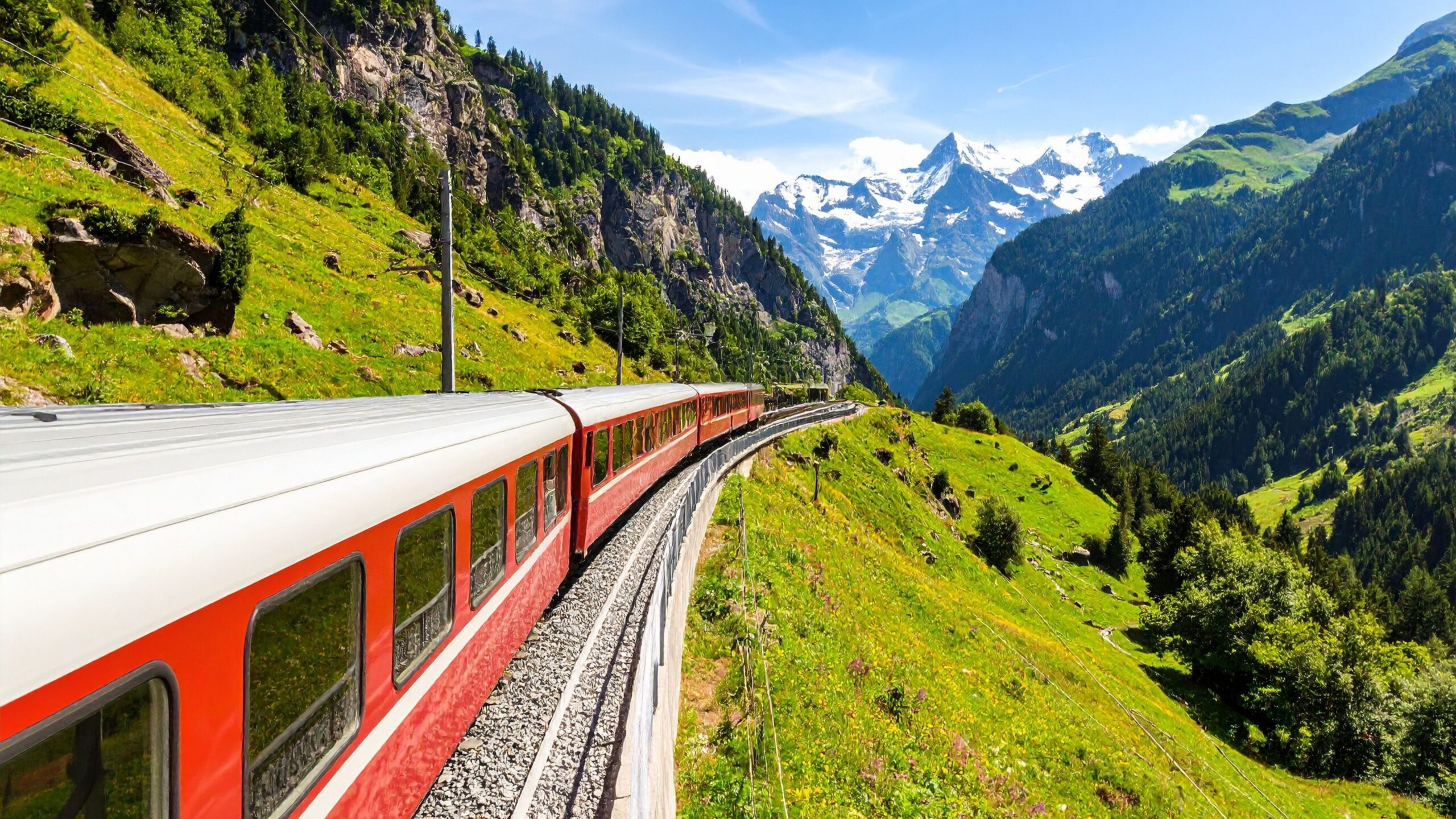
This might be my personal favorite Alps scenic train route for tourists who want maximum drama with minimum fuss. The Bernina Express runs from Chur, Switzerland, to Tirano, Italy, in about 4 hours, crossing the Alps entirely above ground—no long tunnels hiding the views.
The route is a UNESCO World Heritage site, and the engineering alone is worth the ticket. The train climbs to 7,391 feet at the Bernina Pass using only adhesion (no cog wheels), then spirals down into Italy via the famous Brusio circular viaduct. If you’ve seen photos of a red train curving in a complete circle on a stone bridge, that’s this spot.
I rode it on a Tuesday in September when the larches were turning gold. An older Italian gentleman across the aisle kept offering me grappa from a flask and insisting I photograph specific viewpoints. “No, no, the OTHER side now!” he’d shout in accented English whenever we switched from valley views to glacier views. By Tirano, we were sharing his wife’s homemade focaccia. That’s the kind of thing that happens when you travel slowly.
Cost: Around 70 CHF ($80 USD) one-way without reservations (optional), covered by Swiss Travel Pass with mandatory 14 CHF ($16) reservation.
Switzerland Scenic Train Journeys for Beginners: Which Route First?
If you’re new to panoramic train routes in Europe and feeling overwhelmed by options, here’s my honest recommendation based on various scenarios:
First time in Switzerland + limited budget: Take the Bernina Express. It’s the most dramatic for the money, covers two countries, and the 4-hour duration won’t destroy your schedule. Book morning departures forthe best light on the mountains.
Visiting Zermatt anyway: The Glacier Express makes sense if you’re already heading between Zermatt and St. Moritz or vice versa. Otherwise, it’s a long, expensive detour from most Swiss itineraries.
Want the “Swiss experience” without the Switzerland price tag: Consider the Centovalli Railway from Locarno to Domodossola. It’s 40 CHF, takes 2 hours, crosses gorgeous gorges and valleys, and most tourists have never heard of it. I rode it on a whim and loved every minute.
Luxury vs. Budget Scenic Train Journeys: What You Actually Get
Let me be blunt about something the travel blogs won’t say: luxury scenic train journeys worldwide offer wildly different value propositions depending on where you are.
The Rocky Mountaineer’s $3,200 GoldLeaf service gets you:
- Glass-dome car with assigned seating
- All meals (actually good meals)
- Alcohol included
- Hotel in Kamloops
- Luggage handling
- Basically, you sit down, and they handle everything
Meanwhile, Switzerland’s trains operate more democratically. The panoramic cars on the Bernina Express? Any ticket class can sit there. You’re not segregated by price. The “luxury” versions mainly add food service and guaranteed window seats via reservations.
I’ve done both luxury and budget scenic train journeys worldwide, and here’s what I’ve learned: the luxury trains are worth it when they offer exclusive access to better views or routes you can’t do otherwise. When does luxury just mean slightly softer seats and a meal you could easily pack yourself? Skip it and pocket the difference.
Most Beautiful Mountain Train Journeys Beyond the Rockies and Alps
Flåm Railway, Norway
This 12-mile journey drops 2,838 feet from mountain to fjord in 50 minutes. It’s one of the steepest railway lines in the world on standard gauge track, and the Norwegian government built it purely for tourists—it goes nowhere useful for commuters.
I rode it in July during the midnight sun season. The train stops at Kjosfossen waterfall, and a woman in traditional dress aappearson a rock above the falls, “singing” to recorded music in a tradition called the huldra legend. Touristy? Absolutely. Still magical? Somehow yes.
Cost: Approximately 520 NOK ($48 USD) one-way, round trips around 700 NOK ($65). Book through Vy.no or Flamsbana.no.
Jungfrau Railway, Switzerland
This route to Jungfraujoch, the “Top of Europe” at 11,332 feet, is technically in Switzerland but deserves its own mention. Most of the journey happens inside a tunnel blasted through the Eiger mountain, but the destination—standing at Europe’s highest railway station surrounded by glaciers—makes it bucket list worthy.
Real talk: it’s expensive. The round trip from Interlaken costs around 200 CHF ($225 USD) even with a Swiss Travel Pass discount. Is it worth it? If the weather cooperates and you get clear views, absolutely. I went on a foggy day and basically paid $225 to stand in a cloud. Check the webcam before committing.
Long Distance Scenic Train Journeys Worth Every Hour
The Ghan, Australia
I haven’t ridden this one yet—it’s on my 2025 list—but based on extensive research and friends’ reports, The Ghan from Adelaide to Darwin deserves mention. This 1,851-mile journey through the Australian Outback takes 54 hours and shows you the red center of Australia, impossible to experience any other way.
According to Journey Beyond Rail’s 2024 pricing, Gold Service cabins start around $2,800 AUD ($1,850 USD) per person. Platinum Service—with a double bed and better food—runs $5,500+ AUD ($3,640 USD). The train stops for off-train excursions at Katherine and Alice Springs.
The Trans-Siberian Railway
The ultimate long-distance scenic train journey. Moscow to Vladivostok covers 5,772 miles over 7 days. This isn’t luxury—it’s adventure travel on rails. Most travelers book through specialized agencies, with costs varying wildly from $800 for a basic second-class sleeper to $3,000+ for first-class private compartments with better food and amenities.
My friend Sarah rode it last summer and said the key is treating it like a moving hotel, not a scenic experience per se. The landscape shifts from European Russia to Siberia to the Far East, but hours can pass with nothing but endless taiga forest. The real adventure is the journey itself—the strange train station stops, the people you meet, and the slow rhythm of travel, much like exploring European cities to visit in winter, where atmosphere and experience matter more than constant visual spectacle.
Common Mistakes & Hidden Pitfalls When Booking Scenic Train Routes
After helping friends plan trips and making my own errors, here are the mistakes that cost people money or ruin experiences:
Booking the wrong season: I learned this the hard way. Many Canada rocky mountains train trips only run from April through October. Book for June or September—summer peak (July-August) is crowded and expensive, while early/late season offers better pricing and fewer tourists with nearly identical weather and scenery.
Not understanding Swiss Travel Passes: Switzerland’s rail system seems designed to confuse tourists. A Swiss Travel Pass covers many scenic trains, but NOT the seat reservations often required. Budget an extra $50-100 for a reservation fee,s even with a pass. Also, the pass coverfewerss of the high-mountain routes like Jungfrau (you still pay roughly 75% of full price).
Sitting on the wrong side: Some routes have dramatically better views on one side. The Rocky Mountaineer solves this with rotating seats, but on European trains, you’re stuck. Research which side to request when booking. For the Glacier Express, right side heading Zermatt to St. Moritz gives you Rhine Gorge views. For Bernina Express, the left side heading from Switzerland to Italy gets you glacier views.
Forgetting to eat: This sounds stupid, but I’ve watched tourists realize 3 hours into an 8-hour journey that the Glacier Express restaurant car is reservation-only and fully booked. If the train doesn’t include food, pack substantial snacks. Switzerland’s train station shops sell excellent sandwiches, fruit, and chocolate.
Underestimating travel time to/from train stations: Scenic trains often depart from small mountain towns, not major airports. Getting to Zermatt from Zurich takes 3.5 hours by train. Banff to Vancouver is 13+ hours, even before the Rocky Mountaineer journey starts. Build in buffer days.
Booking too close to departure: Luxury scenic train journeys book months in advance, especially for summer. The Rocky Mountaineer’s best dates sell out 9-12 months ahead. Even Switzerland’s “regular” trains can fill reservation spots 6-8 weeks out in peak season.
Ignoring weather: Mountain weather changes fast. I’ve been on train journeys where visibility dropped to 50 feet in sudden fog. You can’t control this, but checking forecasts and being flexible with dates,s if possible, helps. Most scenic trains run year-round, and winter scenes can be equally spectacular (sometimes more so).
My 2026 Prediction: These Routes Will Explode in Popularity
Based on booking trends I’m seeing and talking with tourism boards, here’s my contrarian take: the famous scenic train journeys worldwide are about to get uncomfortably crowded, while second-tier routes see massive growth.
The Glacier Express already hits capacity regularly in summer. The Rocky Mountaineer sold out nearly every July and August departure in 2024. Meanwhile, routes like Norway’s Dovre Railway (Oslo to Trondheim), Austria’s Semmering Railway, and Scotland’s West Highland Line offer 85% of the experience at 40% of the cost with a fraction of the crowds.
I think 2026-2027 will be the turning point where savvy travelers actively seek alternatives to the “famous” routes. The infrastructure exists, the scenery’s comparable, and eventually, people get tired of fighting for reservations and paying premium prices.
Best Scenic Trains for First-Time Rail Travelers
If you’ve never done a serious train journey and want to dip your toes in, start with something manageable:
In North America: Consider the Amtrak Coast Starlight from Seattle to Los Angeles (or any scenic section of it). Yes, Amtrak has issues, but the route through Oregon and along the California coast is genuinely beautiful, and you’ll know quickly if long-form train travel is your thing. Cost: around $150-$300, depending on class and route section.
In Europe: The GoldenPass Express (Interlaken to Montreux, 3.25 hours, around $80) offers everything Switzerland’s famous for—mountains, lakes, villages—in an easy half-day journey. Perfect for testing if you want to commit to longer routes.
For luxury sampling: The Napa Valley Wine Train in California costs $150-$300 for a 3-hour round trip with meals. It’s very touristy, and the scenery isn’t remotely in the same league as the Rockies or Alps, but it lets you experience “fancy train travel” without the international logistics or $3,000 price tag.
Practical Tips for Train Journeys with Mountain Views
Bring a microfiber cloth for wiping condensation or smudges off windows. This sounds silly until you’re trying to photograph the Matterhorn through foggy glass.
Download offline maps and entertainment. WiFi on scenic trains ranges from “surprisingly decent” (Rocky Mountaineer) to “completely nonexistent” (most European mountain routes). I usually download a few podcasts and resign myself to actually looking out the window for hours. Revolutionary concept.
Charge devices before boarding. Not all trains have outlets at every seat, particularly older rolling stock or second-class cars.
Dress in layers. Mountain trains experience dramatic temperature swings. You might start in 70°F valley sunshine and end at 40°F mountain elevation, or vice versa. The Bernina Express transitions from Swiss snow to Italian palm trees in four hours.
Book window seats, obviously, but specifically aisle-side windows if traveling alone. You get the view without climbing over people for bathroom breaks. Though on Swiss trains, most people are polite about letting you out.
The Real Cost of Scenic Rail Journeys: Beyond the Ticket Price
Let’s talk about what iconic mountain train journeys worldwide actually cost when you factor everything:
Example: 5-Day Switzerland Rail Trip
- Swiss Travel Pass (4 days): $310
- Glacier Express reservation: $55
- Bernina Express reservation: $16
- Jungfrau ticket (with pass discount): $115
- Hotels (4 nights, mid-range): $800
- Food (not included on most trains): $300
- Actual total: $1,596 per person before flights
Example: Rocky Mountaineer with Extensions
- Rocky Mountaineer (2 days, GoldLeaf): $2,800
- Hotel in Vancouver (2 nights): $400
- Hotel in Banff (2 nights): $500
- Transfers and tips: $150
- Food not on train: $200
- Actual total: $4,050 per person before flights
These numbers assume moderate choices, not luxury-everything or extreme budget travel. Scenic train journeys around the world can be done for less by choosing economy classes, hostels, and packing food, but baseline costs add up faster than people expect—much like planning weekend wellness getaways, where small upgrades and conveniences quickly influence the final budget.
Is Slow Travel Worth It in 2025?
I get asked this constantly: why would you spend 8 hours on a train covering a distance you could fly in 90 minutes?
Here’s the thing—that’s exactly the wrong question. Train travel for scenery, not speed, isn’t about efficiency. It’s about experiencing the landscape at a human scale, watching transitions happen gradually instead of teleporting between airports.
When I flew from Vancouver to Calgary, I saw the mountains from 35,000 feet for maybe 15 minutes between clouds. When I took the Rocky Mountaineer, I spent 16 hours winding through those same landscapes—watching the light change, spotting wildlife, and truly understanding the geography. They’re not comparable experiences, just like how taking time to plan a bike trip turns travel into an immersive journey rather than a quick transfer from point A to point B.
The slow travel movement isn’t about rejecting modern life—it’s about choosing intentionality over optimization sometimes. Some trips should be about getting there fast. Others should be about never wanting to arrive.
Resources for Booking Scenic Train Journeys
After riding these routes, here are the most reliable booking platforms I’ve found:
Rocky Mountaineer: Book directly through RockyMountaineer.com. Third-party sites don’t save money and can complicate changes.
VIA Rail (Canada): VIARail.ca is the official site. Sign up for their email list—they run sales, cutting prices 40% several times per year.
Swiss Railways: SBB.ch/en is the official Swiss rail site. It’s honestly better than third-party rail pass sites, showing all options clearly. The mobile app is excellent.
Seat61.com: Not a booking site, but the single best resource for understanding rail travel logistics worldwide. The guy behind it (Mark Smith) has forgotten more about trains than most travel agents ever knew.
Rail Europe: Decent for comparing multiple European routes, though you’ll sometimes find better prices booking directly with national rail companies.
Lonely Planet’s Rail Journeys: Their book “Epic Train Journeys” (2023 edition, available on Lonely Planet’s site) influenced this article and offers 50+ routes with practical details.
Making It Happen: Your First Scenic Train Journey
If I’ve convinced you to try this—and I hope I have—start simple. You don’t need to do a $4,000 luxury trip across Canada or spend a week riding the Trans-Siberian on your first attempt.
Pick one route that interests you. Book it. Go.
Maybe it’s the Bernina Express because you’ve got a week in Europe anyway and can add it easily. Maybe it’s the Coast Starlight because it’s domestic and you can test the waters. Maybe you’re the type who goes all-in and books the Rocky Mountaineer for your anniversary.
The specific route matters less than breaking the habit of treating trains purely as transportation. Once you experience one journey where the window becomes better than any screen you own, where hours pass without checking your phone, where you have actual conversations with strangers because there’s nothing else to do—you’ll understand why people like me keep choosing the slow way.
I’m writing this from a train right now—nothing especially scenic, just a regional train in Germany heading to Munich. But the late afternoon light is hitting snow-covered fields in a particular way, the guy across from me is sharing his apple cake, and even though I’ll arrive about 45 minutes later than if I’d driven, I’ll get there calmer and happier. Moments like this are why train travel across Europe feels less like transportation and more like part of the journey itself.
That’s what these journeys teach you: sometimes, later is better.
Key Takeaways
- Rocky Mountaineer and Glacier Express represent peak luxury scenic rail travel, but routes like Bernina Express and VIA Rail’s Canadian offer comparable experiences at lower costs for budget-conscious travelers.
- Research which side of the train to sit on before booking—it can make or break the experience on routes where dramatic scenery favors one side.
- Swiss Travel Passes cover train tickets, but not mandatory seat reservations—budget an extra $50-100 for reservation fees even with a pass.
- The VIEWS scoring system (Visual Impact, Infrastructure Quality, Ease of Booking, Worth the Cost, Story Potential) helps objectively evaluate whether a scenic train route justifies its price and logistics.
- Book luxury scenic trains 9-12 months ahead for peak season—routes like Rocky Mountaineer sell out nearly a year in advance for summer departures.
- Second-tier scenic routes in Norway, Austria, and Scotland offer 85% of the famous-route experience at 40% of the cost with far fewer crowds, making them ideal for 2026-2027 travelers.
- Slow travel isn’t about rejecting efficiency—it’s about choosing intentional experiences where the journey becomes as memorable as the destination itself.
- Real costs exceed ticket prices significantly—a Swiss rail trip ticket might be $170, but hotels, food, reservations, and transfers typically add $1,000-1,500 to the total trip cost.
FAQ Section
Q: What’s the best time of year to take scenic train journeys in the Rockies and Alps?
A: For Canadian Rockies routes like the Rocky Mountaineer, September offers the sweet spot—stunning fall colors, fewer crowds than summer, and stable weather. The trains typically operate from April through October only. For the Alps, trains run year-round, but May-June and September-October balance great weather, snow-capped peaks, and manageable tourist numbers. Winter in the Alps can be magical, but some high passes may have reduced visibility.
Q: Can I use rail passes on luxury scenic trains, or do I need separate tickets?
A: It depends on the train. Luxury private trains like Rocky Mountaineer require separate tickets always—rail passes don’t apply. In Switzerland, a Swiss Travel Pass covers the actual fare on routes like Glacier Express and Bernina Express, but you still must pay mandatory seat reservation fees ($16-55 depending on route). Standard regional trains throughout the Alps are fully covered by passes with no extra fees.
Q: How far in advance should I book famous scenic train routes?
A: For luxury routes like Rocky Mountaineer’s peak season (July-August), book 9-12 months ahead as they genuinely sell out. For Swiss scenic trains, booking 6-8 weeks ahead in summer ensures you get reservations, though the trains themselves rarely fully sell out. Shoulder seasons (May, September, October) offer more flexibility,y with 3-4 week bookings usually sufficient.
Q: Are scenic train journeys suitable for young children or elderly travelers?
A: Generally yes, with caveats. Luxury trains like Rocky Mountaineer welcome families, but eight-hour days sitting still challenge kids under age 7. Swiss trains are extremely accessible with level boarding, but routes with altitude changes (Jungfrau railway tops out above 11,000 feet) may affect elderly travelers with heart or respiratory conditions. Most scenic routes fall somewhere in between—comfortable seating, frequent stops, easy bathroom access—making them more accessible than long flights.
Q: What’s the most budget-friendly way to experience world-class scenic train routes?
A: VIA Rail’s Canadian offers the best value for multi-day journeys at $800-1,600 compared to Rocky Mountaineer’s $1,500-3,200. In Europe, the Centovalli Railway ($35-45) and regional panoramic trains without mandatory reservations provide spectacular alpine scenery at a fraction of famous-route costs. Booking second-class seats, packing your own food, and traveling shoulder season can cut total trip costs by 40-50% while maintaining 80% of the experience.